
Transient LASSO: Transient Large-Scale Scene Reconstruction
-
Dominik Scheuble
-
Andrea Ramazzina
-
Hanno Holzhüter
-
Stefano Gasperini
- Steven Peters
-
Federico Tombari
- Mario Bijelic
- Felix Heide
SIGGRAPH Asia 2025
While most neural reconstruction methods operate on RGB images or lidar point clouds, we explore scene reconstruction using transient video data. Transient imaging — measuring the time-of-flight of light at picosecond resolution — has been investigated extensively as a method to recover scene information from light transport. However, transient imaging in outdoor scenes has struggled with interference from ambient light and the different sensor behavior under high-photon-flux conditions. We introduce Transient LASSO, a neural scene reconstruction method operating on raw transient measures of outdoor in-the-wild captures to accurately reconstruct the underlying scene geometry and properties. We demonstrate the effectiveness of our method across a variety of outdoor environments, including complex urban scenes with dense traffic and infrastructure. Finally, we also show the potential use cases of our method for applications such as sensor parameter control.
Transient LASSO: Transient Large-Scale Scene Reconstruction
Dominik Scheuble, Andrea Ramazzina, Hanno Holzhüter, Stefano Gasperini, Steven Peters,Federico Tombari, Mario Bijelic, Felix Heide
SIGGRAPH ASIA 2025
Scene Reconstruction and Decomposition
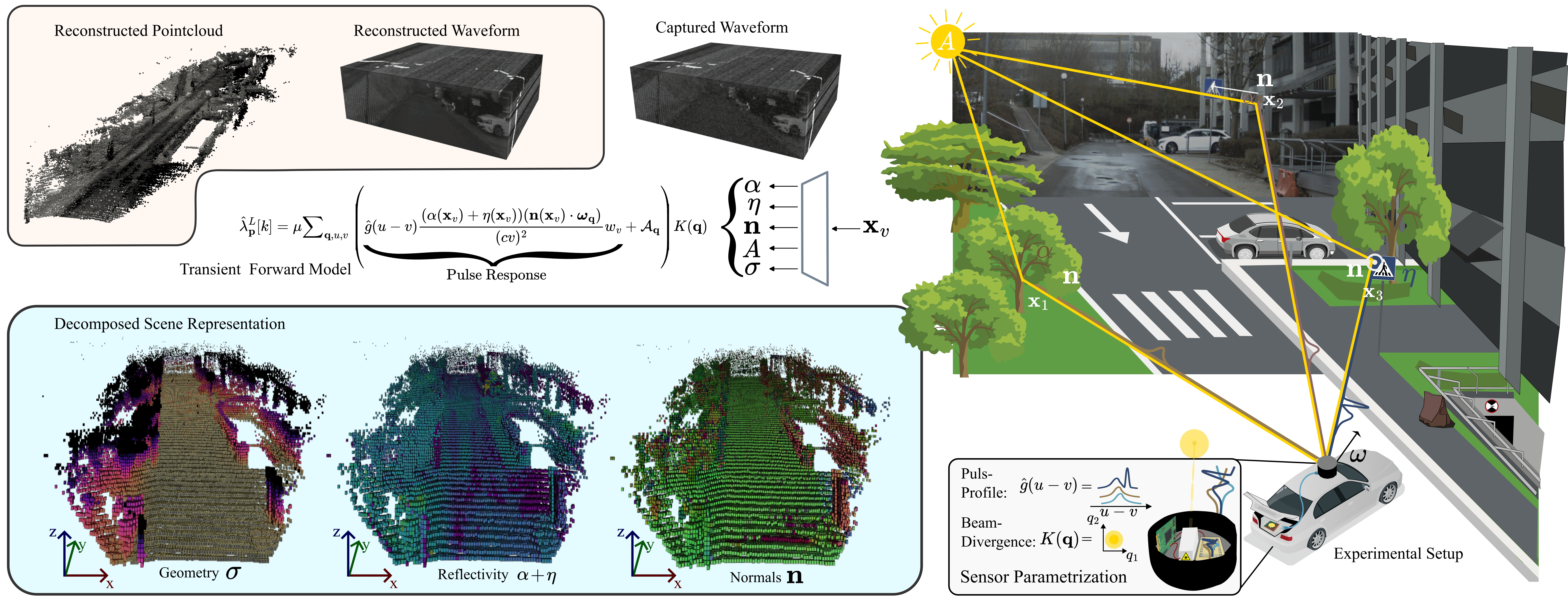
Transient LASSO allows for decomposing measurements into reflectivity and dense geometry using only a single driving trajectory of transient LiDAR data. Our approach is built upon a realistic imaging formulation model that explicitly simulates both the back-reflected and ambient light components in the scene.
Starting from a set of posed raw transient LiDAR measurements, Transient LASSO reconstructs the scene by disentangling geometry and normals from the material properties (reflectivity) and the ambient light.
Transient data is re-rendered with an explicit image formation model that ingests these disentangled scene components as well as optimizable LiDAR sensor parameters. As shown on a sample of our custom dataset on the left, this approach enables to accurately recover fine-grained details of outdoor scenes recorded in varying conditions. The video confirms that our method can correctly disentangle the different scene properties. Specifically, Transient LASSO correctly estimates the road and car surface normals, the complex geometry of trees and roadside structures, as well as the high reflectivity of road markings and traffic signs.
Transient Neural Field
We represent the scene as a neural field f : {x} → {σ, n, α, η, A} mapping each point in space x to its volumetric density σ, normal n, albedo α, retroreflectivity η and ambient light A, shown in the figure below. We employ two multi-headed neural fields, to model respectively the geometry and appearance of the scene. Both fields share a spatial embedding χ via multi-resolution hash encoding H.
We then reconstruct the noise-free transient waveform for low- or high-flux conditions, through a time resolved volume rendering approach.
Scene & Sensor Parameter Control
Transient LASSO enables explicit control of scene and sensor parameters. This allows sensor manufacturers and autonomous vehicle developers who can replace expensive sensor tests with Transient LASSO in order to, e.g., determine how certain hardware parameters influence downstream detection performance or point cloud quality in challenging conditions.
To showcase the ability of Transient LASSO for scene and parameter control, we alter the ambient component as well as the laser pulse power.
As visualized below, increasing the ambient light component by a factor 10 (top row), renders the pulse invisible from the background. Conversely, with a higher pulse power, the propagating laser pulse remains visible at greater distances (bottom row).
Quantitative Results
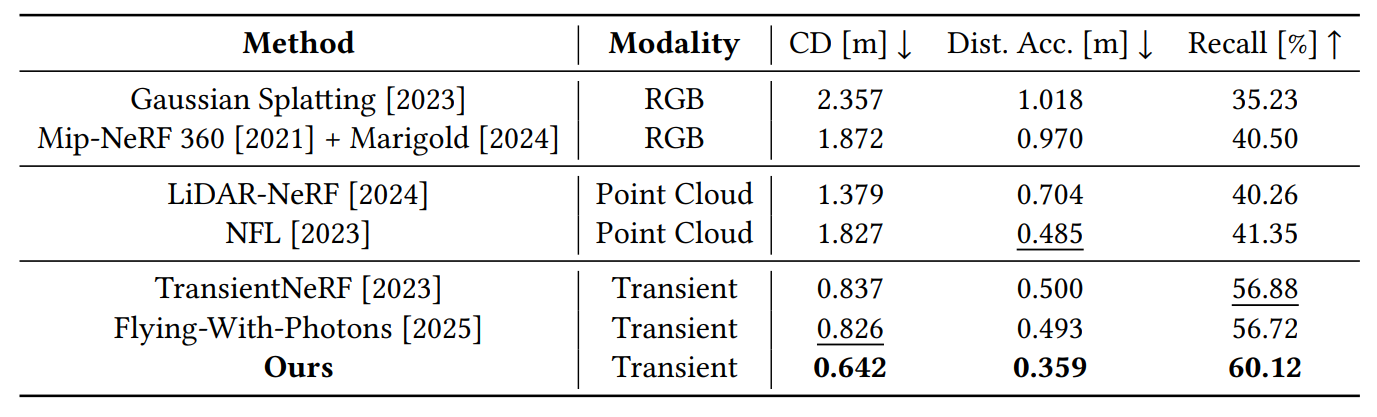
We evaluate the 3D reconstruction quality by comparing the ground truth with a pointcloud of the scene obtained by querying the fitted neural scene representation. As metrics, we use the Chamfer Distance (CD), Distance Accuracy and Recall, as reported on the table on the right. Our proposed method outperforms competing baselines operating on both raw (waveform) or processed (extracted pointclouds) and RGB signal.
Related Publications
[1] Dominik Scheuble, Hanno Holzhüter, Steven Peters, Mario Bijelic, and Felix Heide. Lidar Waveforms are Worth 40x128x33 Words. ICCV 2025
[2] Andrea Ramazzina, Stefanie Walz, Pragyan Dahal, Mario Bijelic and Felix Heide. Gated Fields: Scene Reconstruction from Gated Videos. CVPR 2024
[3] Dominik Scheuble, Chenyang Lei, Seung-Hwan Baek, Mario Bijelic and Felix Heide. Polarization Wavefront Lidar: Learning Large Scene Reconstruction from Polarized Wavefronts. CVPR 2024