
Holographic Display Étendue Expansion with a Binary π-Metasurface
- Congli Wang
- Zhihao Zhou
- Ethan Tseng
- Victor Chu
- Wei Ting Chen
- Johannes E. Fröch
- Arka Majumdar
- Felix Heide
Optics Letters 2026
Holographic Display Étendue Expansion with a Binary π-Metasurface
Congli Wang, Zhihao Zhou, Ethan Tseng, Victor Chu, Wei Ting Chen, Johannes E. Fröch, Arka Majumdar, and Felix Heide
Holographic Display Étendue Expansion with a Binary π-Metasurface
Optics Letters 2026
System and Metasurface
A fiber-coupled RGB laser illuminates a Texas Instruments 4-bit piston-mode phase light modulator (PLM, 10.8 µm cells) through a beamsplitter. A 1:1 relay with a Fourier-plane iris and DC stop images the PLM onto the metasurface, and a Fourier lens forms the far-field hologram on a monochrome camera.
The metasurface was fabricated by SNOChip Inc. It covers 13.8 mm × 8.6 mm on a 0.5 mm fused-silica substrate. Each 10.8 µm supercell, matched one-to-one to a PLM mirror, holds either 191 nm or 336 nm diameter SiN nanopillars, 640 nm tall on a 386 nm lattice. The two pillar populations are the two states of a random binary mask.
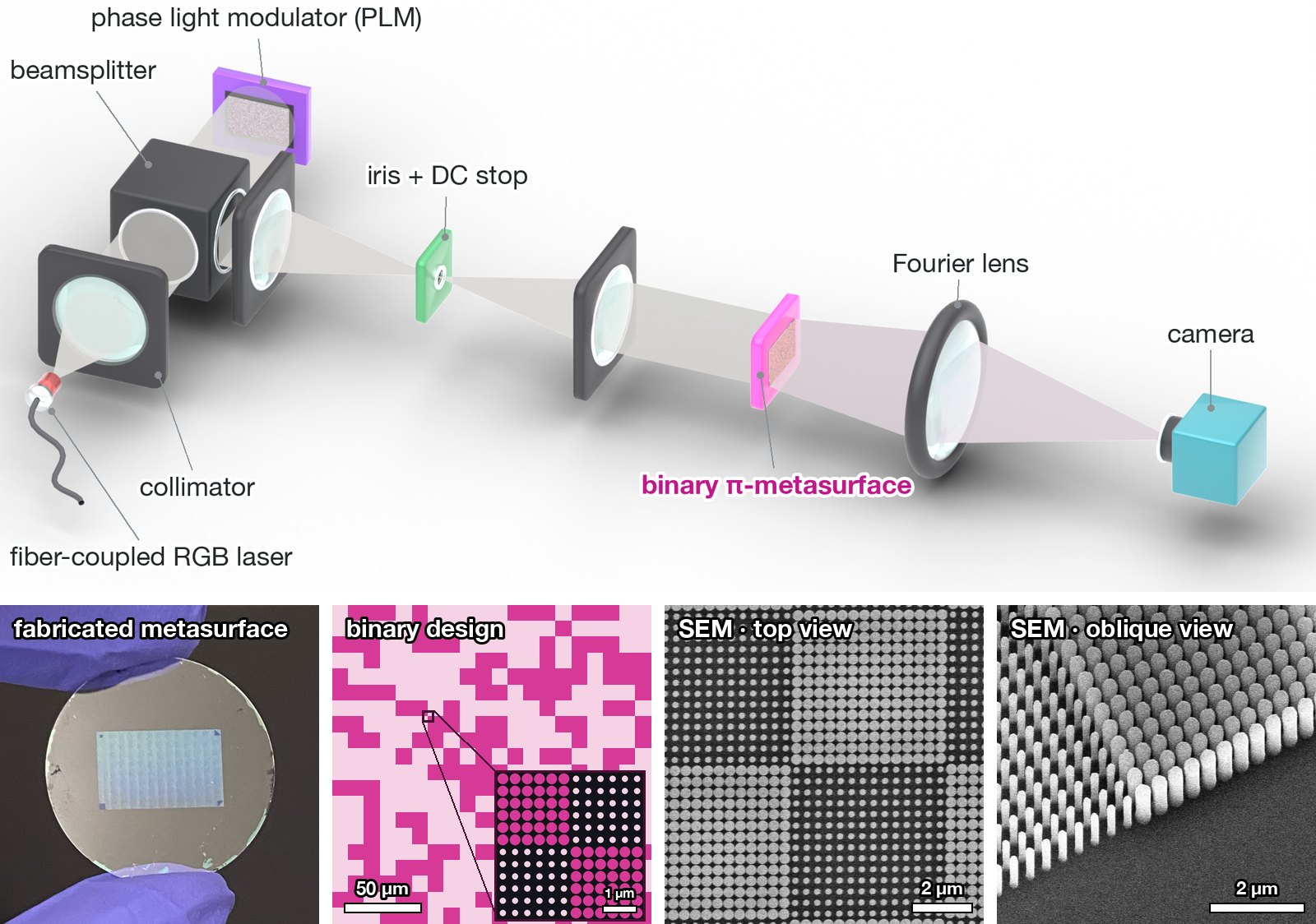
Top: optical layout; the widening beam after the pixel-registered metasurface indicates the expanded angular support. Bottom, left to right: the fabricated metasurface on its fused-silica substrate; a patch of the designed random binary mask, each square one 10.8 µm supercell (pink: 336 nm pillars, pale pink: 191 nm pillars), with a to-scale inset of the pillars where two states meet; scanning electron micrographs (top and oblique views) of the fabricated nanopillars. Scale bars: 50 µm (design) and 1 µm (inset), 2 µm (SEM).
Near-Achromatic π Phase Step
The phase step of a conventional binary diffractive optical element (DOE) scales as 2π(n−1)h/λ. It is exactly π at one design wavelength and drifts away everywhere else. Any departure from π leaves an unscattered fraction |c0(λ)|² of the light that bypasses the expander and lands as an unexpanded ghost copy of the hologram. A DOE designed for π at 520 nm leaks 7.0% at 450 nm and 11.9% at 660 nm; one designed at 660 nm leaks 51.2% of the blue.
The metasurface’s two pillar populations are dispersion-engineered so their phase difference stays within 13° of π on average over 400–700 nm in full-wave simulation, apart from a 560–595 nm resonance. The simulated zero order is 0.27%, 1.31% and 2.75% at 450, 520 and 660 nm. The DOE remains exact at its own 520 nm design point, so the metasurface’s advantage lies at the outer primaries. On the fabricated element we measure 9.1%, 7.5% and 3.5%, above simulation, but the worst channel stays below the DOE’s 11.9% and far below the 51.2% of a 660 nm design.
Sweeping the wavelength (scalar simulation, s = 4, K = 8, ideal continuous phase modulator). Top: the ring target reconstructed at the marked wavelength through each element. Bottom: the unscattered fraction for the 520 nm-designed binary DOE (analytic) and the metasurface (full-wave simulated zero order), with the three laser primaries marked and the meta-atom resonance shaded.
Ghost Suppression in Simulation
We simulate full-color far fields of a color-ring target at s = 4, a 16× areal expansion, on an ideal continuous phase-only modulator with K = 8 multiplexed solutions per color. Without an expander, the image is confined to the un-expanded support. Both passive elements address the enlarged field.
The 520 nm-designed DOE, driven with holograms designed for an ideal π step, passes its unscattered fraction into the central un-expanded zone as a ghost, strongest at 450 and 660 nm. The metasurface, with holograms optimized against its simulated response, keeps that zone darker: signal-to-background contrast inside it is 3.0:1, against 1.8:1 for the DOE, with a faint residual only at 660 nm.
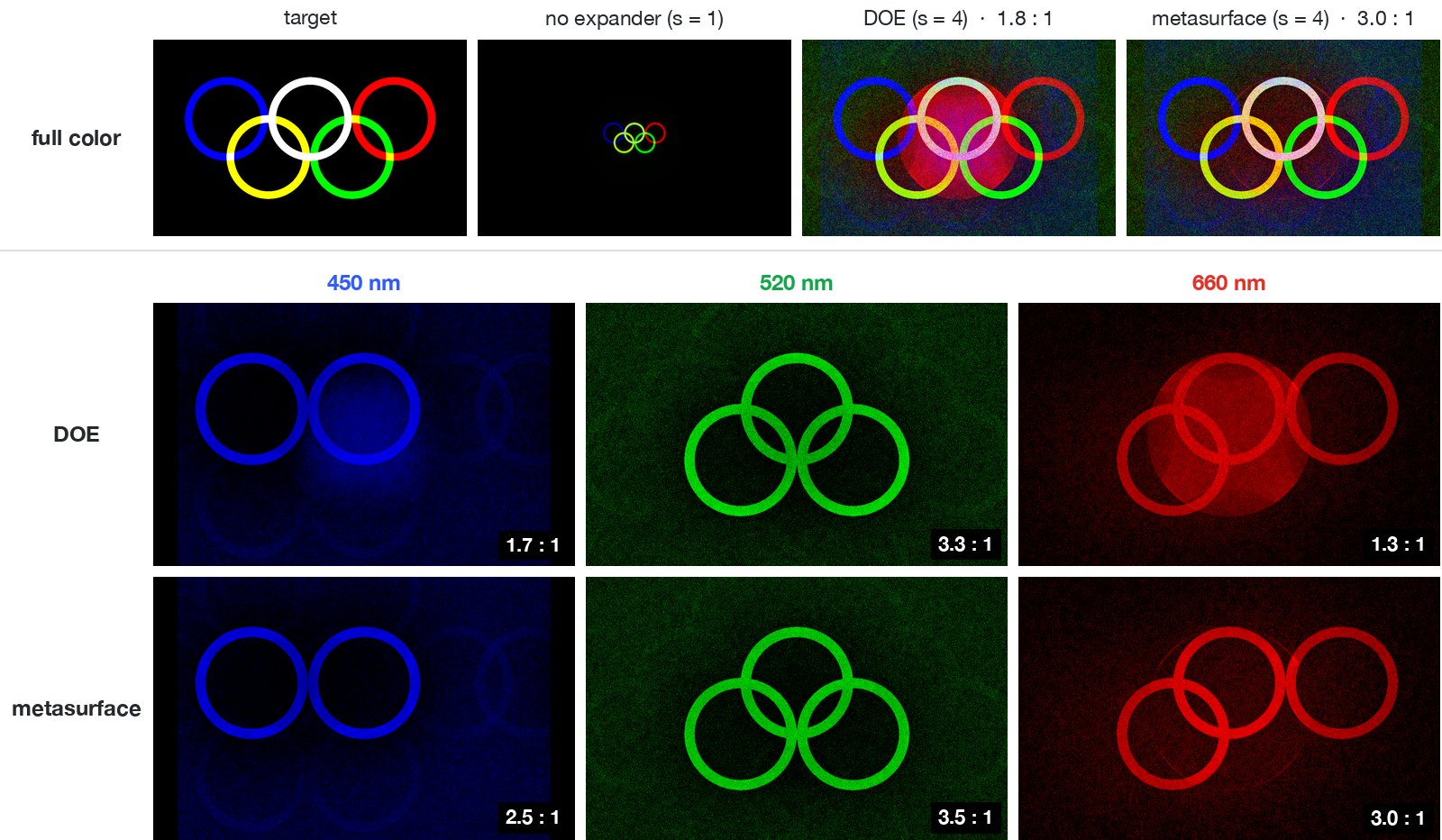
Simulated reconstructions of a color-ring target. Top: full color (450/520/660 nm), showing the target, no expander (s = 1), a binary DOE with π at 520 nm (s = 4) and the metasurface (s = 4). Bottom: per-wavelength channels of the two expanders. Ratios give the signal-to-background contrast inside the un-expanded ghost zone.
Experimental Findings
We ran experimental captures at s = 2 to test the fabricated metasurface expander. The 450, 520 and 660 nm channels are captured as sequential monochrome exposures through the same passive metasurface, and they reconstruct each target at matched positions. Each capture averages K = 24 separately optimized patterns per color.
The simulation propagates the same displayed patterns through the scalar model. Every hologram is optimized against the nominal π mask, so a chromatic phase step would show up only in the captures, as a ghost raising the background. Instead, the measured background contrast stays at a common fraction of the model prediction at all three primaries. Residual background haze and speckle-softened detail leave the measured composites 2 to 5 dB below simulation in color PSNR on most subjects (values are in Supplementary).
Measured three-color holograms of all ten subjects through the metasurface, alternating with the scalar model’s rendering of the same displayed patterns. 450, 520 and 660 nm; s = 2; K = 24 subframes per color.
Related Publications
[1] Ethan Tseng, Grace Kuo, Seung-Hwan Baek, Nathan Matsuda, Andrew Maimone, Florian Schiffers, Praneeth Chakravarthula, Qiang Fu, Wolfgang Heidrich, Douglas Lanman, Felix Heide. Neural Étendue Expander for Ultra-Wide-Angle High-Fidelity Holographic Display. Nature Communications 2024
[2] Victor Chu, Oscar Pueyo-Ciutad, Ethan Tseng, Florian Schiffers, Grace Kuo, Nathan Matsuda, Albert Redo-Sanchez, Douglas Lanman, Oliver Cossairt, Felix Heide. Artifact-Resilient Real-Time Holography. ACM Transactions on Graphics 2025